Here’s the mistake people make with insulation rebates: they hear “up to $1,250” or “up to $7,700,” assume it’s close to free, and book the work on that basis.
The rebate is real and worth having. But it’s 50% of your cost, capped — not a cheque for the headline number. Whether it’s worth building your decision around depends entirely on your specific house.
So instead of just listing the amounts, let’s run them — on a house that looks like a lot of Newmarket. Figures verified against the official program as of July 2026.
The example house
A typical Newmarket two-storey detached, built in the 1990s:
- Attic measured at roughly R-22 (installed in the 90s, settled since)
- Bonus room over the garage that’s always cold
- Unfinished basement the family is thinking about finishing
- An unsealed rim joist (there almost always is)
We’ll carry this house through both rebate paths and see what actually comes back.
The two paths
| Standalone attic | Bundled upgrades | |
|---|---|---|
| Energy assessment? | No | Yes — before and after |
| Upgrades needed | Attic only | Two or more |
| Attic maximum | $1,250 | $1,500 |
| Total insulation maximum | $1,250 + $750 | $7,700 |
| Contractor | Closed pre-approved list only | Any qualified contractor |
You use one path or the other for the same attic — not both.
Scenario A: Just the attic (standalone path)
Our example attic is at R-22, so it lands in the middle bracket:
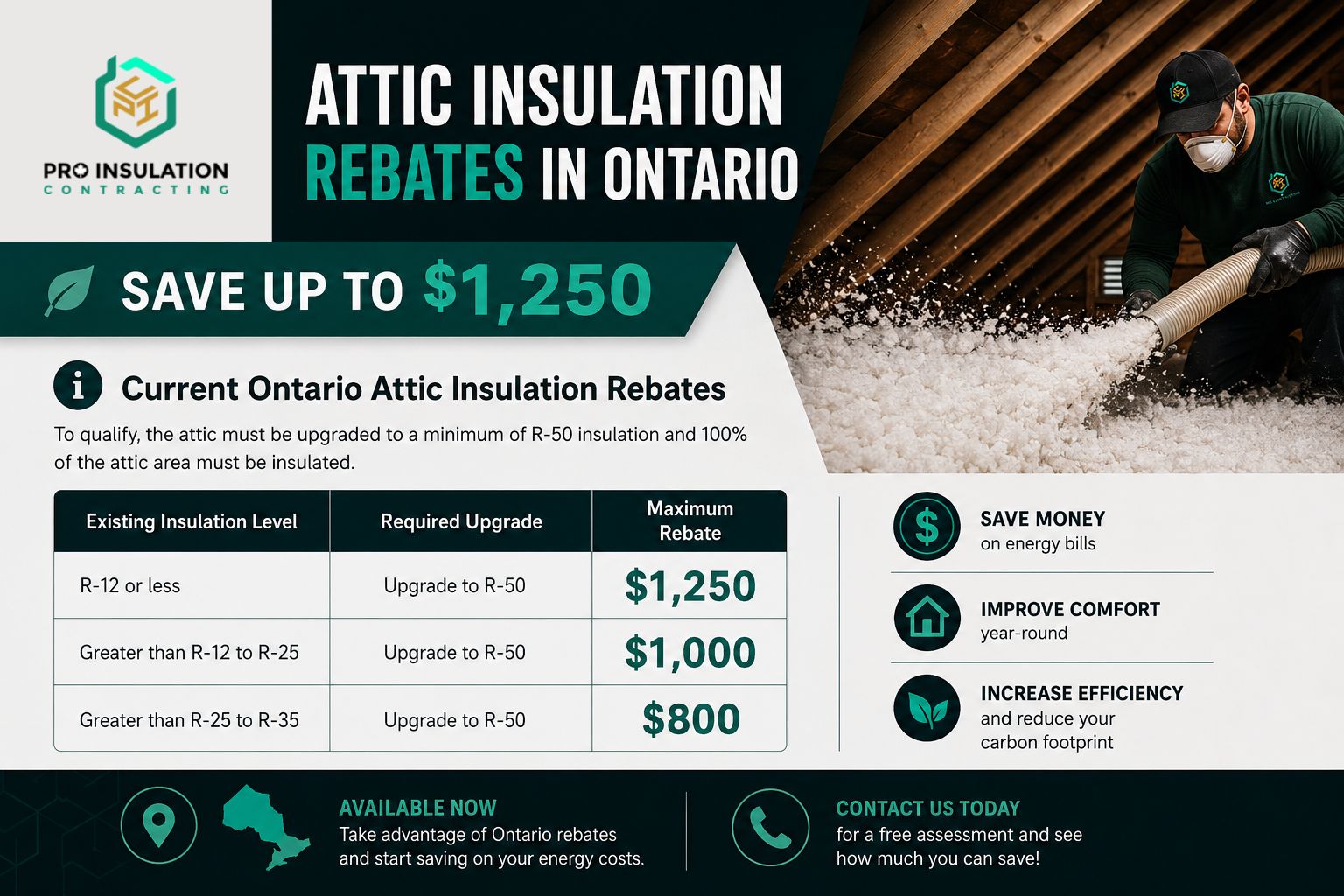
| Existing insulation | Must reach | Maximum |
|---|---|---|
| R-12 or less | R-50 | $1,250 |
| Over R-12, up to R-25 ← our house | R-50 | $1,000 |
| Over R-25, up to R-35 | R-50 | $800 |
So the cap is $1,000. Now the rule that people miss:
The rebate is 50% of your after-tax attic cost, up to that cap.
Two outcomes depending on job cost:
| Attic job cost (incl. HST) | 50% of cost | Cap | Rebate | Net cost to you |
|---|---|---|---|---|
| $1,800 | $900 | $1,000 | $900 | $900 |
| $2,200 | $1,100 | $1,000 | $1,000 | $1,200 |
| $3,000 | $1,500 | $1,000 | $1,000 | $2,000 |
What this tells you: past a certain job size, the rebate stops growing — you’ve hit the $1,000 cap. The rebate covers half of a modest attic job and a shrinking fraction of a larger one. It’s a genuine discount, not a giveaway.
Also required: you must insulate 100% of the attic and reach R-50. No doing the easy two-thirds.
Scenario B: Attic + more (bundled path)
Now suppose this family does the attic and finishes the basement, or does the attic and the rim joist. That unlocks the bundled path, where the attic pays more and several other measures qualify.
Our R-22 attic on the bundled path:
| Existing | Must reach | Bundled attic rebate |
|---|---|---|
| Over R-12, up to R-25 ← our house | R-50 | $1,200 |
That’s $200 more than the standalone cap, just for being part of a bundle. Then add whatever else qualifies:
| Measure on our example house | Bundled rebate |
|---|---|
| Attic to R-50 (from R-22) | $1,200 |
| Foundation header / rim joist | $300 |
| Basement walls (if finishing) | up to $1,500 |
| Air sealing | $200–$250 |
| Realistic total | $1,700 – $3,250 |
The two-upgrade minimum is the only hurdle, and it’s low — attic + rim joist alone clears it. The insulation ceiling on this path is $7,700, so there’s a lot of headroom before the cap bites.
Full bundled table, for reference
| Upgrade | Requirement | Rebate |
|---|---|---|
| Attic | To R-50 (brackets) | $900 – $1,500 |
| Cathedral / flat roof | To R-28 or R-20 | $780 |
| Exterior walls | To 100% of area (brackets) | $1,200 – $3,600 |
| Basement walls | To 100% (brackets) | $900 – $1,500 |
| Basement slab | 50%+, min R-3.5 | $500 |
| Foundation header | 80%+, min R-20 | $300 |
| Crawlspace walls | To 100% (brackets) | $600 – $1,200 |
| Crawlspace ceiling | To 100% | $1,200 |
| Exposed floor | R-20+, min 120 sq ft | $300 |
| Air sealing | Meet / beat target | $200 / $250 |
| Windows & doors | ENERGY STAR, min qty | $100 per opening |
| Heat pump water heater | ENERGY STAR | $500 |
But: the bundled path costs you a paid energy assessment (before and after) and takes longer. That cost is usually small next to the extra rebate — but it’s real, and it’s why the path only makes sense if you’re genuinely doing two or more measures.
So — is it worth it? The honest answer
This is the part the headline numbers don’t address.
The rebate should be a tiebreaker, not the reason.
- If you were going to insulate anyway — cold upstairs, high gas bills, a comfort problem you want solved — the rebate is straightforwardly good. It knocks 30–50% off a job you’d already decided to do. Take it.
- If the rebate is the only reason you’re considering the work — you’re comfortable, bills are fine, you just heard there’s money available — do the math above first. On a capped 50% rebate, you still pay the majority of the cost. “Getting $1,000 back” means spending $1,000–$2,000 of your own money. That only makes sense if you value the comfort and energy savings independently.
The genuine value case for a house like our example isn’t the rebate. It’s that an R-22 attic is costing money every winter, the bonus room is unusable, and the work pays back in comfort and lower bills over time. The rebate just makes an already-sensible upgrade cheaper.
Be sceptical of any pitch that leads with the rebate number and skips the part where you still pay half.
How the bundled path works — and where people lose it
- Pre-retrofit energy assessment with a registered energy advisor — before any work. There’s a fee; ask what it is. ⚠️ Start work before this and it’s disqualified. Most common mistake.
- Renovation Upgrade Report — rebates come only from measures it recommends.
- Complete at least two recommended upgrades. ⚠️ Do one and you get nothing.
- Follow-up assessment, same advisor.
- Rebates issued after the advisor submits.
Standalone path is simpler: confirm eligibility on the official site (it returns the participating contractors — the standalone stream is delivered only by a closed pre-approved list), do the work, contractor submits, you’re paid as an Enbridge bill credit or cheque.
Timing: book in summer, not January
Peak insulation demand in Ontario runs October–February. Energy advisors and contractors both book out. On the bundled path you need two appointments with the same advisor — start in November and you could be waiting out the winter you wanted to be warm for.
Booking in late spring or summer means availability, work finished before the cold, and the rebate processed before you’ve forgotten about it. There’s also no guarantee the program runs forever — terms allow it to change or end at any time, so a completed rebate beats a planned one.
Eligibility, briefly
Own the home; detached, semi-detached, standard row/townhouse, or mobile on permanent foundation. Excluded: stacked townhouses; new builds occupied ≤6 months; homes that already got an attic rebate from Enbridge Gas, Save on Energy, the Ontario government, or this program. Heating: Enbridge Gas furnace/boiler, or electricity/oil/propane/wood on Ontario’s grid. Stacking: no combining with other Enbridge/Save on Energy/Ontario incentives for the same measure; combined rebates can’t exceed 50% of after-tax cost.
Federal programs
- Canada Greener Homes Grant — closed to new applicants
- Canada Greener Homes Loan — closed to new applications as of October 1, 2025, per NRCan. Already-approved homeowners continue.
Any site still advertising “up to $10,000 from the Canada Greener Homes Loan” is out of date. NRCan’s newer Canada Greener Homes Affordability Program is income-targeted and delivered through provincial partners — confirm Ontario availability at natural-resources.canada.ca.
Scam warning: the program has published a notice about fake sites and people impersonating approved contractors. Verify through official channels: homerenovationsavings.ca/scams
Frequently asked questions
How much will I actually get back? 50% of your after-tax cost, up to your bracket cap — $800–$1,250 standalone depending on existing R-value, or more across a bundle up to the $7,700 insulation ceiling. Run your own numbers using your existing R-value and quoted cost.
Why isn’t it the full $1,250? $1,250 is the top-bracket cap, and only if your existing insulation is R-12 or less and your job is large enough that 50% of its cost reaches $1,250. Most homes land below that.
Is the rebate worth the hassle? If you were insulating anyway, yes. If the rebate is your only motivation, do the math first — you still pay at least half.
Do I need an energy audit? Not for the standalone attic path. Yes for the bundled path, before and after.
What’s my existing R-value? Measure the attic depth and convert — here’s how. It sets your bracket before anyone quotes you.
Can I start work before the assessment? No — on the bundled path that disqualifies it.
Who gets the money? The homeowner, as an Enbridge bill credit or cheque.
My attic is already R-40. Above R-35 existing, the attic doesn’t qualify — but other measures in your home may, on the bundled path.
Get a quote that shows the math
The only way to know whether the rebate is worth building around is to see your actual numbers: your existing R-value, your bracket, the job cost, 50% of that cost, and your net. We put all of it in writing rather than implying a headline figure.
Pro Insulation Contracting has insulated Ontario homes for over 10 years and serves Newmarket and York Region. We’ll measure what you have, tell you which path fits, and quote a fixed price with the rebate position spelled out.
📞 (416) 315-0471 · Book a free assessment →
Attic insulation in Newmarket → · Spray foam in Newmarket →
Rebate details verified against homerenovationsavings.ca and natural-resources.canada.ca on July 27, 2026. Government programs change frequently and can be modified or ended without notice. Confirm current terms on the official program website before making a financial decision.