There’s a complaint we hear more than any other in Newmarket’s two-storey homes: the upstairs is stifling in July and freezing in January.
Same rooms. Opposite seasons. Same cause.
If that’s your house, the thermostat isn’t the problem and neither is the furnace. It’s almost always the attic — and specifically, an attic that was insulated once, to the standard of its build year, and has quietly lost ground ever since.
Here’s what’s actually happening up there and what to check before you spend anything.
Why the same rooms are both too hot and too cold
It seems contradictory until you understand what the attic does.
Your attic sits directly above your second floor. In summer, sun hits the roof, the attic superheats — easily to 50–60°C on a hot day — and that heat radiates down into the bedrooms below. In winter, the reverse: heat from your living space rises and escapes through the attic, and the upstairs can’t hold temperature.
A properly insulated, properly ventilated attic buffers both. It keeps summer heat from driving down and winter heat from escaping up.
An under-insulated attic does neither. So the same second-floor rooms that bake in summer are the ones that won’t warm in winter. It’s not two problems. It’s one thin attic.
This is why “just close the vents” or “add a bigger AC” never quite fixes it — they’re treating symptoms of an attic that isn’t doing its job.
The Newmarket pattern: built in the boom, settled ever since
A large share of Newmarket’s housing went up during York Region’s northern expansion — roughly the mid-1980s through the 2000s. Solid two-storey detached family homes, built quickly during a long construction boom.
Two things follow from that:
It was insulated to the standard of its day. Attic requirements have risen over the decades. A home from that era was insulated correctly for then, which is below where you’d want an attic now.
It’s settled since. Loose-fill insulation compacts over time and batts compress under their own weight. Ten, twenty, thirty years on, the measured depth is meaningfully less than what was installed. Every lost inch is lost R-value.
The result: a house that isn’t old, doesn’t feel like it should have an insulation problem, and does.
Measure what’s actually there — five minutes
- Open the hatch, light on, step only on joists
- Push a ruler to the drywall at several spots, including near the eaves
- Convert:
| Material | R per inch | 8 in | 12 in | 16 in |
|---|---|---|---|---|
| Blown cellulose | ~3.4 – 3.8 | ~R-28 | ~R-42 | ~R-56 |
| Blown fibreglass | ~2.7 – 3.0 | ~R-22 | ~R-34 | ~R-45 |
| Settled batts | ~2.5 – 3.2 | ~R-22 | — | — |
Target: R-50 minimum to protect rebate eligibility, R-60 as the goal where there’s headroom. Most Newmarket homeowners who measure for the first time find they’re under both.
The five things that get skipped — and cause the discomfort
Depth alone doesn’t fix a hot-and-cold upstairs. These do more of the work than the R-value number:
1. Air sealing the ceiling
Insulation slows heat conduction. It barely touches air movement. Your ceiling has unsealed penetrations — plumbing stacks, wiring holes, the tops of interior walls, exhaust-fan housings, and any pot lights added in a later reno. Warm air escapes through them in winter, carrying moisture into the attic; in summer, superheated attic air leaks down the same way.
Seal first, insulate second. Blow loose fill over an unsealed ceiling and the leaks are buried where nobody can reach them.
2. Full coverage to the eaves
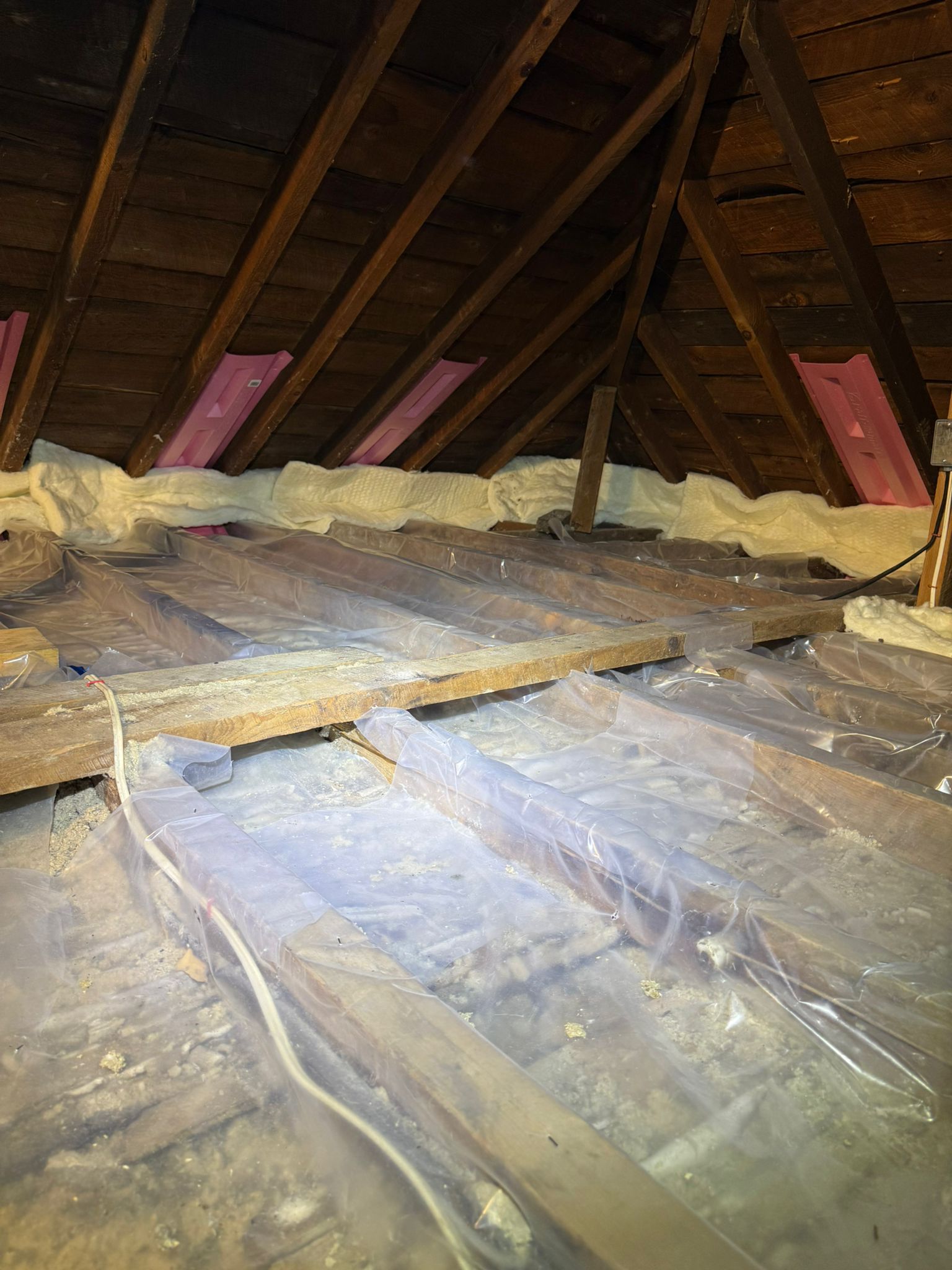
The attic perimeter — where the roof slopes down to the exterior wall — is the hardest area to reach and the first thing shorted when a crew is moving fast. It sits directly above your second-floor rooms. A well-installed R-50 that reaches the edges beats a sloppy R-60 that stops three feet short.
3. Baffles and ventilation
Blown-in insulation buries soffit vents unless baffles hold it back. Blocked soffits kill attic airflow — which is what lets summer heat build up and winter moisture accumulate. Baffles are cheap and go in before the insulation. Baffle installation →
4. The attic hatch
Usually a bare panel with no insulation and no weatherstrip. A hole in your ceiling, right in the middle of the house. Easy to box, insulate and seal — routinely ignored.
5. Attic ductwork
Many Newmarket two-storeys run HVAC supply ducts through the attic to reach the second floor. If those runs are uninsulated or leaking at the joints, you’re heating and cooling the attic — and starving the exact upstairs rooms that feel wrong. Blanket wrap insulation →
The snow-belt factor: ice dams
Newmarket sits at the southern edge of the belt that gets heavier snow the further north you go toward Barrie. That makes ice dams a real seasonal issue here.
What happens: heat leaking into the attic warms the roof deck, snow melts, the water runs to the cold eaves and refreezes into a ridge of ice. Water then backs up behind it, under the shingles, and into your ceilings.
The cause isn’t the cold — it’s heat and air escaping into the attic, plus poor ventilation. So the fix is the same building science as everything above: air seal the ceiling, insulate to full depth out to the eaves, and keep the attic ventilated so the roof deck stays cold and uniform. Adding insulation without the air sealing and ventilation often just moves the problem around.
The cold room over the garage isn’t part of this
Worth stating, because it’s common in Newmarket’s two-storey stock and gets lumped in with attic complaints.
If a bedroom or bonus room over the attached garage is always cold, that floor sits above an unheated garage, not below the attic. More attic insulation won’t fix it. The fix is closed-cell foam in the garage ceiling. Garage ceiling insulation →
What a proper job looks like
- Assess and measure — depth, material, ventilation, penetrations, ductwork
- Remove only if contaminated by mould, water, rodents or smoke — otherwise top up, R-values add
- Air seal the ceiling plane
- Install baffles and confirm soffit intake
- Box and insulate the hatch
- Seal and insulate attic ductwork where present
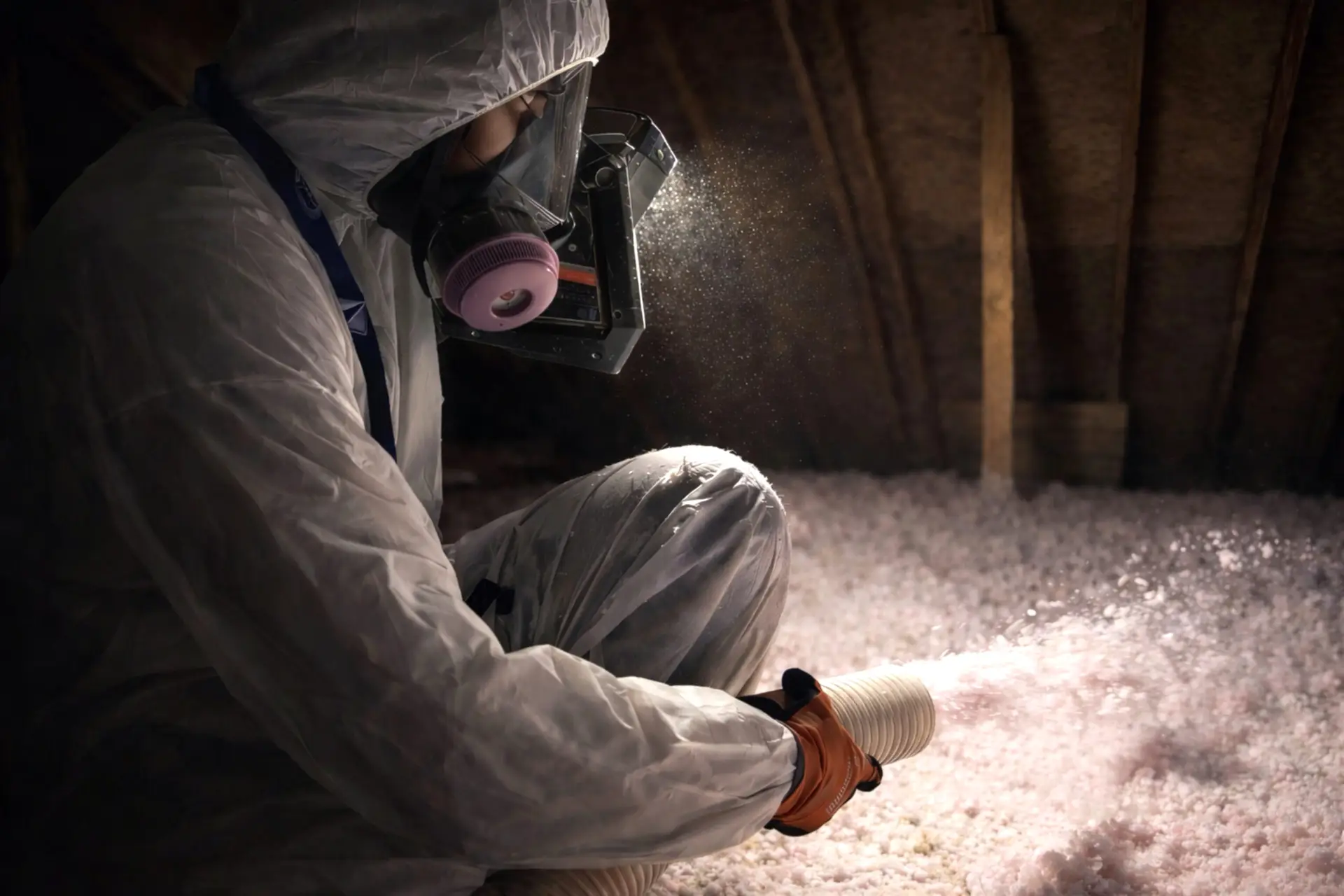
- Blow to depth, out to the eaves — R-50 minimum, R-60 target
- Mark depths so the result is verifiable
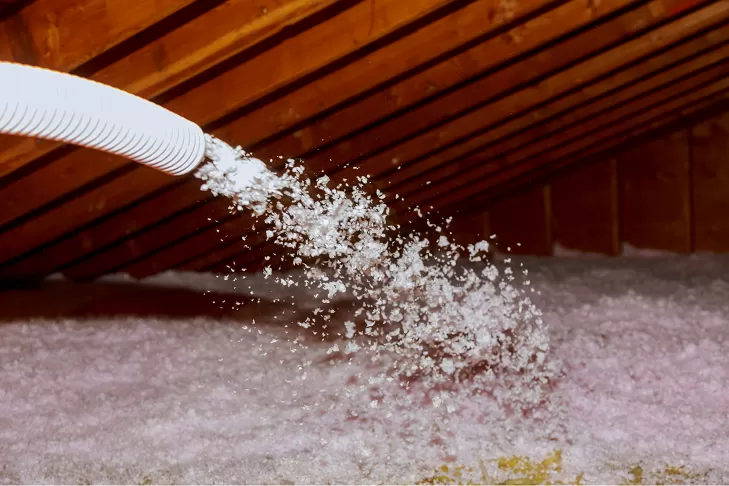
On material: with the headroom in a typical Newmarket truss attic, either works. Cellulose reaches the target in less depth and is denser; fibreglass is lighter and usually the lower-cost route to the same number. Both are rebate-eligible.
Cellulose blown-in → · Fibreglass blown-in → · Insulation removal →
Frequently asked questions
Why is my upstairs hot in summer and cold in winter? Almost always an under-insulated or under-ventilated attic. It fails to buffer heat in both directions, so the second floor tracks the attic instead of the thermostat.
My house is only from the 1990s. Can it really need more insulation? Yes. It was insulated to the standard of that decade and has settled since. Measure the depth rather than assuming.
Does insulation really settle? Yes — loose fill compacts and batts compress. Measured depth after years is less than what was installed.
Do I need to remove the old insulation? Only if contaminated. Otherwise new goes over old and the R-values add.
Why do I get ice dams? Heat and air leaking into the attic plus poor ventilation. The fix is air sealing, full-depth insulation to the eaves, and airflow — not just more insulation.
Do I have to leave home during the work? No.
How long does it take? A straightforward top-up is usually a single day.
Get it measured before you get it quoted
If your upstairs never feels right, the attic is where to start — and the only way to know what it needs is for someone to measure the depth, check the ventilation and ductwork, and look for what’s been skipped.
Pro Insulation Contracting has insulated Ontario homes for over 10 years and serves Newmarket and the surrounding York Region communities. Free on-site assessment, written scope covering air sealing, baffles, hatch, ductwork and depth — and a fixed price before any work starts.
📞 (416) 315-0471 · Book a free attic assessment →