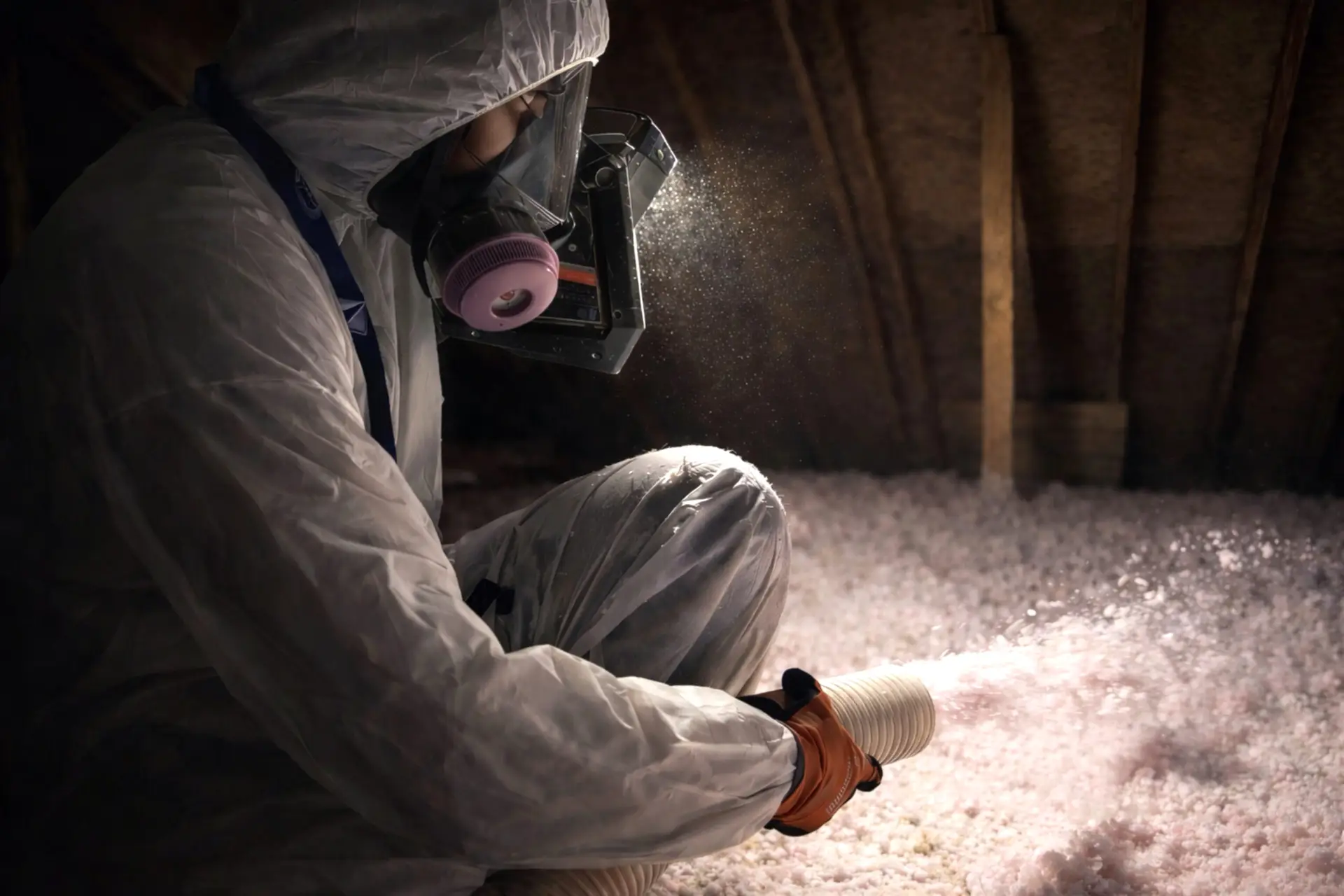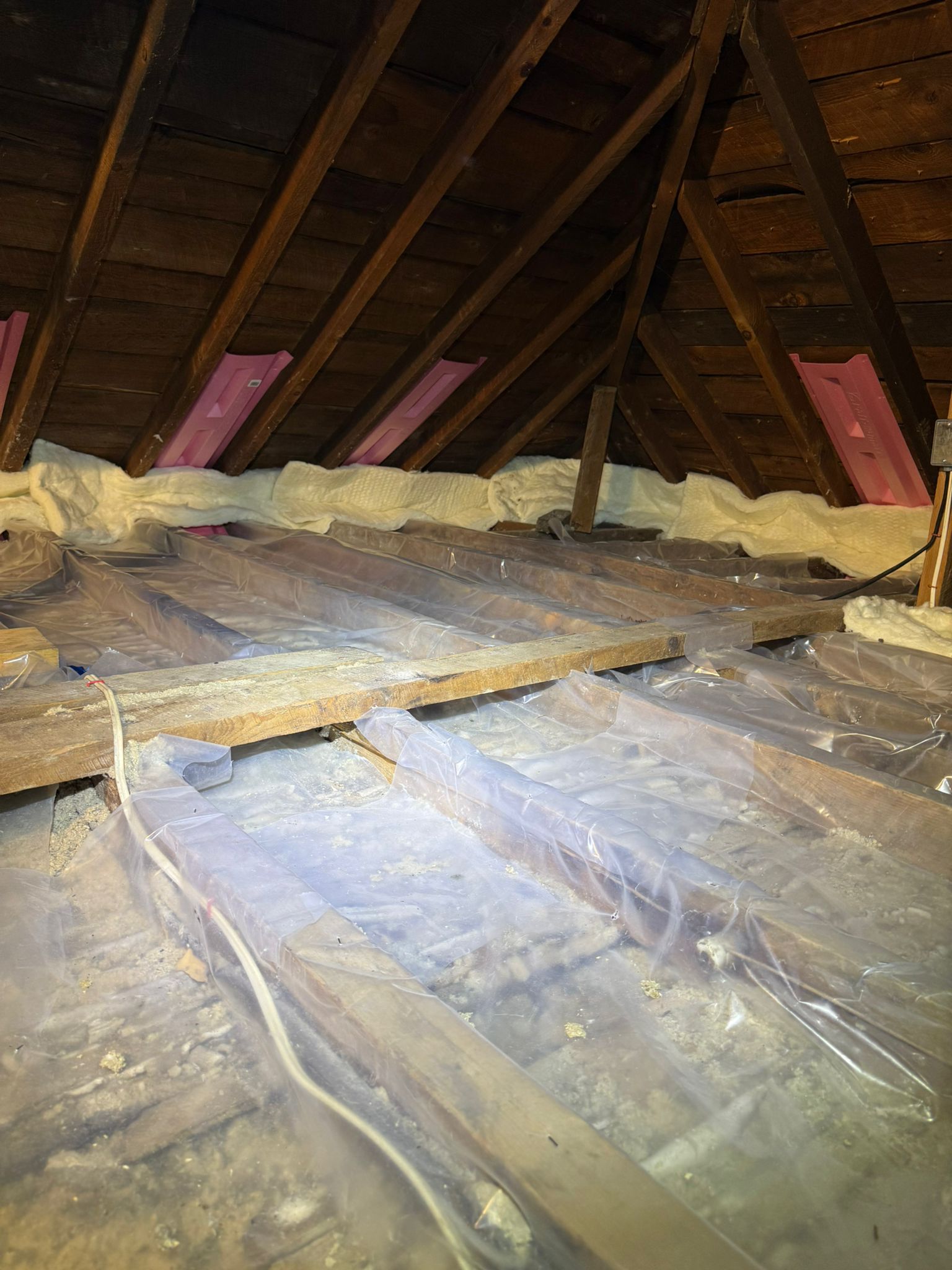
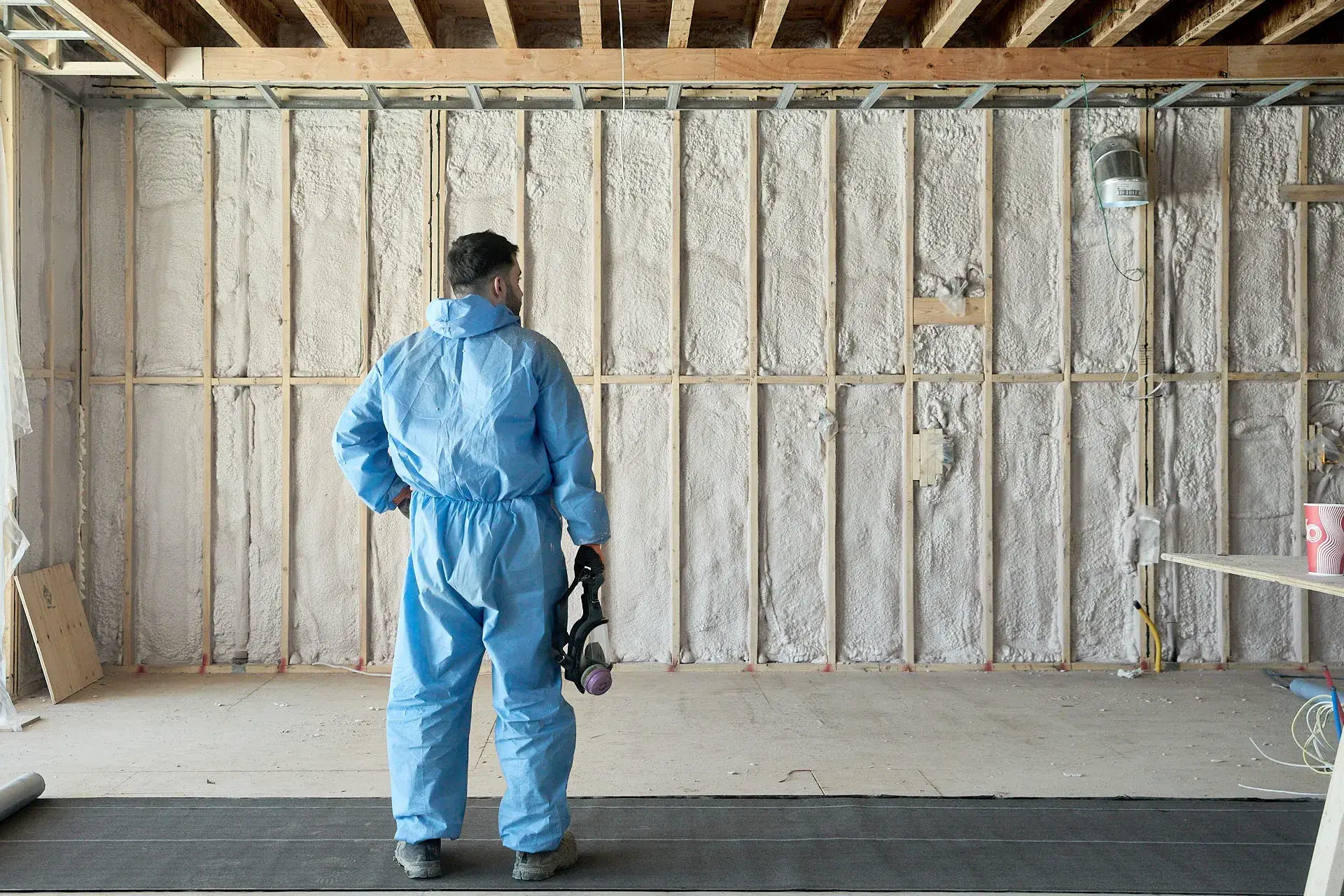
Spray foam is the most expensive insulation we install. In a large Newmarket family home, it’s the right choice in about four specific places — and a waste of money in several others.
Most contractor pages won’t tell you the second half of that. We will, because we install blown-in and batt too, so we keep the job either way and have no reason to push you toward the pricey product where it isn’t needed.
Here’s the honest, room-by-room version for a busy two-storey house.
What spray foam does that other insulation doesn’t
Every insulation slows heat transfer — that’s R-value. Spray foam adds something the others don’t: it stops air movement.
Two liquids mix at the gun, expand on contact, and bond to every surface in the cavity. No gaps at the edges, no channels for air to move through. Since air leakage drives a big share of both heat loss and noise transfer, that seal is what makes foam worth its premium — in the right spots.
The trade-off: it costs more per square foot, it’s permanent, and it needs professional application. Use it where air sealing or moisture control is the real problem. Don’t use it where cheaper insulation does the same job.
Open-cell vs closed-cell — the split that matters in a house full of rooms
| ½ lb open-cell | 2 lb closed-cell | |
|---|---|---|
| Approx. R per inch | ~R-3.5 – R-3.8 | ~R-6.0 – R-7.0 |
| Structure | Soft, flexible | Rigid, dense |
| Own vapour barrier? | No | Yes, at sufficient thickness |
| Moisture | Absorbs water | Resists water |
| Sound dampening | Better | Poorer |
| Cost | Lower | Higher |
Note the sound row — it matters more in this article than any other, because a big family home has more interior walls, more floors between people, and more reasons to want them quiet.
½ lb open-cell → · 2 lb closed-cell →
Where it pays off
1. The bonus room over the garage
The most common comfort complaint in Newmarket’s two-storey stock, and the clearest foam case in the house.
That room’s floor sits over an unheated garage. Builder batts don’t air seal, cold garage air moves through them, and the floor stays cold no matter how high you set the thermostat. Adding more batts or a space heater treats the symptom forever.
The fix: remove the garage ceiling drywall, remove the batts, spray closed-cell foam into the joist cavities sealing the perimeter, reinstate 5/8″ fire-rated drywall (required between an attached garage and the living space). More invasive than people expect, and the only version that reliably works. Garage ceiling insulation →
2. Sound — between floors and around key rooms
This is the one families care about most and plan for least.
A teenager’s basement, a home office that needs to be quiet during calls, a media room, a bedroom over the family room — in a full house, sound transfer between spaces is a daily irritation.
The right products here are open-cell foam and acoustic mineral wool, not closed-cell. Open-cell’s soft structure absorbs sound; closed-cell’s rigidity actually transmits it. For floors between levels, mineral wool in the joists (often with resilient channel) does the heavy lifting.
Do it while walls or ceilings are open — during a basement finish, a renovation, or new construction. Retrofitting sound isolation into finished assemblies means opening them back up. Safe and Sound acoustic insulation →
3. The rim joist
The band of framing around the top of the foundation, usually holding a scrap of fibreglass or nothing. It’s a continuous air leak around the whole house — cold air in, draughty basement, cold first floor.
Closed-cell foam seals and insulates it in one pass. Small area, big effect, and it’s one of the cheapest qualifying rebate measures ($300 on the bundled path) if you need a second upgrade.
4. Basement walls, if you’re finishing
If you’re finishing the basement — common in these homes as kids get older — closed-cell foam applied directly to the foundation wall insulates and controls vapour in one operation, and keeps the framing on the warm, dry side. Framing and filling with batts against a foundation wall, without a proper vapour strategy, is how mould shows up behind the drywall a few winters later. Vapour barrier installation →
Basement walls carry their own rebate (up to $1,500 on the bundled path).
Where it usually isn’t worth it
Your attic
If you have a standard truss attic with headroom — which most Newmarket homes do — blown-in cellulose or fibreglass reaches R-60 for considerably less than spray foam. The attic floor is easy to access and depth is cheap up there. This is the single most common place homeowners are quoted foam when they don’t need it. We install both and we’ll tell you straight. Attic insulation in Newmarket →
Interior walls where you only want warmth, not quiet
A standard interior partition that isn’t a sound or moisture concern doesn’t need foam. Batts plus proper air sealing are fine.
As a fix for a problem that isn’t insulation
- A hot upstairs from undersized return ducts — foam won’t fix it
- Ice dams from blocked soffit vents — ventilation fixes it, not foam
- A damp basement from grading and downspouts — fix the water first
Be wary of anyone who shows up with one product and finds a use for it in every room. A proper assessment names the actual cause before recommending anything.
Practical questions
Do I need to leave the house during installation? We install Insulthane Extreme by Elastochem and residents can generally remain in the home. We’ll discuss ventilation and re-entry timing for the specific area being sprayed, and if anyone in the household has significant respiratory sensitivities, tell us in advance so we can plan around it.
How long does a garage ceiling take? It’s multi-stage — drywall removal, foam, then re-drywall, tape and finish. The finishing drives most of the timeline; we’ll give you the schedule at quote stage.
Do I have to re-drywall the garage ceiling? Yes — fire separation between an attached garage and the living space is required, and the foam has to be covered.
Will foam make my house too airtight? A house sealed thoroughly without adequate ventilation can develop humidity and air-quality issues. If we’re air-sealing significant areas, ventilation is part of the conversation, not an afterthought.
Can foam be removed later? Not easily — it bonds permanently. A reason to be sure about the application before committing.
Does spray foam qualify for the Ontario rebate? Rebates are based on the R-value increase and area covered, not the material. Foam qualifies where it meets the thresholds for that assembly. The rebate is capped at a share of project cost, which affects the math on a higher-cost material.
⚠️ Program terms change — confirm at homerenovationsavings.ca.
How we quote
- On-site assessment — the actual garage ceiling, basement, rim joist, or rooms in question. No phone quotes on foam.
- The quote names the product and applied thickness — open-cell or closed-cell, how many inches — so competing bids are comparable.
- Fixed price, up front.
- If foam’s the wrong call, we say so and quote the alternative. We install blown-in, batt, drill and fill and mineral wool too.
📞 (416) 315-0471 · Book a free assessment →